

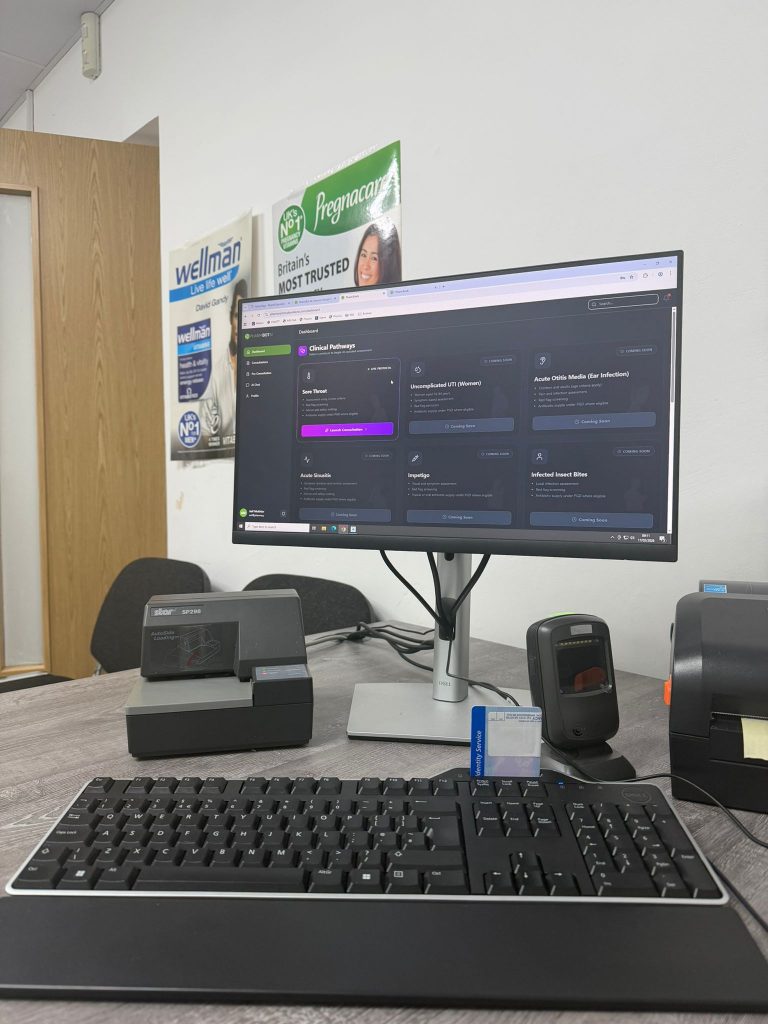
The expansion of the NHS Pharmacy First service has shifted a significant volume of uncomplicated infection management into community pharmacy. Among these conditions, lower urinary tract infection (UTI) in women aged 16–64 represents one of the most common and operationally sensitive pathways.
Unlike sore throat, where clinical scoring systems are widely recognised, UTI management under Pharmacy First is primarily symptom-based. There is no requirement for laboratory confirmation. Urine dipstick testing is not mandated. Diagnosis relies on structured clinical assessment and careful exclusion of systemic or complicating factors.
This creates both opportunity and risk.
As digital consultation platforms increasingly support Pharmacy First delivery, the question is no longer whether UTI consultations can be digitised. The question is how to do so safely, defensibly, and in alignment with the legal framework of a Patient Group Direction (PGD).
PGDs: Delegated Supply, Not Delegated Responsibility
Under a PGD, the legal authority to supply a prescription-only medicine is delegated to a registered healthcare professional who meets specific criteria. The responsibility, however, remains with that professional.
- A digital system cannot make the decision.
- An algorithm cannot assume accountability.
- Artificial intelligence cannot carry legal responsibility.
Therefore, any digital UTI consultation model must be built around a fundamental principle:
The system supports structured decision-making. The pharmacist remains clinically accountable.
Clinical governance must be engineered into the architecture itself.
Symptom-Based Diagnosis: Precision Through Structure
The UTI PGD specifies that supply should be made only when symptoms are consistent with uncomplicated lower UTI and no exclusion criteria are present.
In practice, this requires three structured stages:
- Confirmation of lower urinary symptoms (e.g. dysuria, frequency, urgency, suprapubic discomfort).
- Explicit exclusion of upper UTI or systemic infection (e.g. flank pain, rigors, fever ≥37.9°C, nausea/vomiting).
- Screening for PGD exclusions (e.g. pregnancy, recurrent UTI thresholds, chronic kidney disease, diabetes, immunosuppression, catheter use).
The governance risk arises when this assessment becomes informal, inconsistent, or undocumented.
A robust digital consultation must therefore:
- Require explicit responses to each inclusion and exclusion criterion.
- Prevent silent progression when red flags are present.
- Default to referral where criteria are not met.
- Record all responses in an auditable structure.
This is not about adding friction. It is about making the clinical reasoning visible.
The Role of Deterministic Logic
In digital healthcare, there is a temptation to use large language models or AI systems to “interpret” clinical input.
For PGD-based supply, this approach is unsafe.
Clinical decision logic must be deterministic and rule-based. The pathway from symptom input to outcome must be transparent, testable, and reproducible. If flank pain is present, the system must trigger urgent referral. If recurrent UTI thresholds are met, the system must default to referral. If all inclusion criteria are satisfied and no exclusions apply, PGD supply may proceed.
Only after the decision is made should any generative system be used — and even then, solely for documentation based on structured data.
Governance in this context means separating decision-making from documentation.
Override: Professional Sovereignty with Audit
No digital system should remove the pharmacist’s ability to exercise professional judgement.
However, override must not be invisible.
If a pharmacist proceeds despite a triggered exclusion, the system should:
- Require mandatory justification.
- Record the pharmacist’s identity.
- Timestamp the decision.
- Clearly reflect the override in the consultation record.
This protects the patient, the pharmacist, and the organisation.
Governance is not about restricting clinicians. It is about ensuring transparency when judgement diverges from protocol.
Documentation as a Governance Tool
PGDs require accurate record keeping, including:
- Patient details
- Clinical assessment
- Exclusion screening
- Medication supplied (if applicable)
- Advice provided
- Referral action
- Pharmacist details
In a digital setting, the consultation record should mirror the workflow exactly. There should be no hallucinated text, no inferred examination findings, and no diagnostic embellishment.
If the assessment was history-based, the record should state so clearly.
Structured documentation reduces ambiguity, improves defensibility, and supports audit.
Why This Matters
Lower UTI consultations are common. They are time-pressured. They involve antimicrobial stewardship considerations. They carry the risk of missing pyelonephritis or systemic infection.
As Pharmacy First scales, variation in assessment quality becomes a systemic risk.
Digital infrastructure, if designed correctly, can reduce that variation:
- By enforcing complete exclusion screening.
- By standardising safety-netting advice.
- By ensuring consistent PGD compliance.
- By generating audit-ready records automatically.
But poorly designed systems can just as easily amplify inconsistency.
Clinical governance must therefore be the foundation, not an afterthought.
Beyond UTI
The principles described here are not specific to urinary tract infection. They apply to all PGD-driven services:
- Deterministic logic before generative output.
- Explicit red flag handling.
- Structured audit trails.
- Transparent override.
- Separation of support from responsibility.
Pharmacy First represents a shift in care delivery. The digital systems supporting it must reflect the legal and professional framework within which pharmacists operate.
Digitisation should not dilute governance. It should make it stronger.