

By Asif Mukhtar
Founder & CEO (Consultant Pharmacist), PharmBot AI
Introduction: The Reality We Must Confront
Community pharmacy in 2026 is clinically capable but operationally constrained.
Pharmacists are delivering more services than ever before — from Pharmacy First consultations to independent prescribing pathways — yet the infrastructure underpinning this expansion remains fragmented.
- Manual documentation.
- Disconnected digital systems.
- Repetitive cognitive workload.
- Inconsistent triage processes.
- Limited real-time outcomes reporting.
The ambition for pharmacy is growing. The digital architecture supporting it is not.
If community pharmacy is to become a true front-door clinical service by 2030, the transformation required is not cosmetic. It is infrastructural.
The pharmacy of 2030 will not simply look different.
It will think differently.
From Dispensing Volume to Clinical Intelligence
For decades, community pharmacy has been structurally designed around volume dispensing. Clinical services were layered on top of an operational model built for product throughput.
By 2030, this model will be inverted.
Dispensing will increasingly be automated — whether through centralised hub models, robotic systems, or intelligent stock management. The pharmacist’s value will shift decisively toward:
- Clinical assessment
- Independent prescribing
- Medicines optimisation
- Chronic disease support
- Preventative health interventions
But clinical expansion cannot rely solely on human capacity. The cognitive load involved in consultation, documentation, safety checks, guideline interpretation, and audit compliance is already substantial.
Artificial intelligence will not replace pharmacists.
It will reduce cognitive friction.
AI as Clinical Co-Pilot, Not Replacement
The dominant narrative around AI in healthcare is either hype or fear. Neither is helpful.
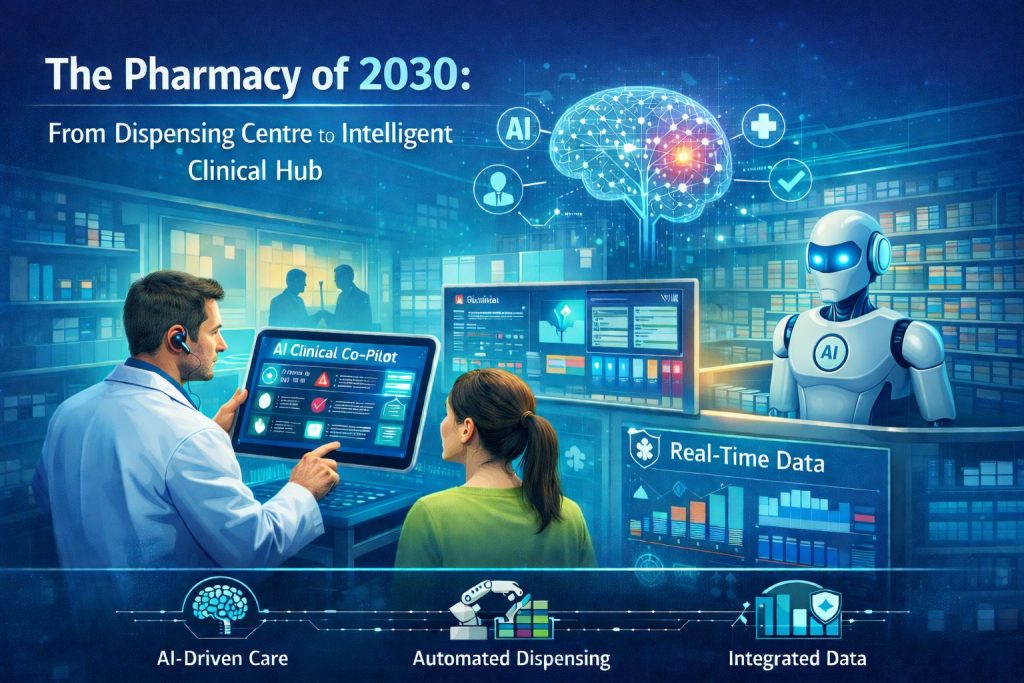
In reality, the most impactful application of AI in pharmacy will be as a regulated clinical co-pilot.
By 2030, the consultation journey may look like this:
- Structured AI Triage
Patients complete structured digital assessments aligned to national service specifications.
- Real-Time Clinical Support
AI surfaces relevant red flags, NICE-aligned decision prompts, contraindications, and interaction alerts during the consultation.
- Automated Documentation
Consultation records are generated in structured formats, reducing manual entry time while preserving full pharmacist oversight
- Integrated Safety Checks
Every decision is logged, auditable, and reviewable — ensuring accountability remains with the pharmacist.
The pharmacist remains in control.
The AI enhances consistency and reduces variation.
This is augmentation — not automation of responsibility.
The Physical Environment of 2030
The pharmacy of 2030 will likely feel different.
- Robotic dispensing systems will handle high-volume items.
- Automated stock analytics will predict demand based on local population data.
- Digital dashboards will display service performance metrics in real time.
- Consultation rooms will function as structured clinical environments rather than ad hoc spaces.
However, the visible hardware is not the most important shift.
The true transformation will sit beneath the surface.
An intelligence layer connecting workflow, governance, documentation, and reporting.
Without that layer, robotics and automation remain isolated tools.
With it, pharmacy becomes an integrated clinical hub.
Governance Will Define the Winners
The difference between speculative AI and deployable AI in NHS pharmacy settings will not be capability — it will be governance.
By 2030, any AI infrastructure supporting pharmacy services must demonstrate:
- Clinical safety case alignment (DCB0129 / DCB0160 principles)
- Structured risk assessment frameworks
- Full audit trails
- Role-based access control
- Transparent decision support logic
- Data protection compliance aligned with UK GDPR
- NHS DTAC-level assurance readiness
AI that cannot evidence governance will not scale in NHS environments.
This is the fundamental shift the sector must understand.
Innovation without assurance will not survive scrutiny.
Data as an Outcome Asset
One of the most underutilised assets in community pharmacy today is structured service data.
By 2030, pharmacies will be expected to demonstrate:
- Clinical outcome measures
- Service utilisation trends
- Population health contributions
- Prescribing pattern insights
- Safety event reporting transparency
ICBs will increasingly require outcome visibility, not just activity reporting.
AI-enabled infrastructure can transform consultation data into structured, analysable outputs in real time — enabling:
- Local service optimisation
- Workforce planning
- Predictive demand modelling
- Strategic commissioning conversations
This moves pharmacy from reactive service provider to data-informed healthcare partner.
The Infrastructure Layer: The Missing Piece
Robotics companies will build dispensing hardware.
Electronic prescribing providers will manage transactional flows.
Wholesalers will optimise supply chains.
But the intelligence layer connecting:
- Clinical workflow
- Structured triage
- Safety oversight
- Documentation
- Compliance reporting
- Outcome dashboards
… remains largely underdeveloped in community pharmacy.
The pharmacy of 2030 will require an operating system for clinical services.
An AI-enabled, pharmacist-governed infrastructure layer that standardises how consultations are structured, recorded, supported, and audited.
Without this layer, digital tools remain fragmented.
With it, pharmacy can scale safely.
What This Means for Today
2030 is not far away.
Pharmacies preparing for that future must begin asking:
- How structured are our consultation processes?
- How reproducible are our clinical decisions?
- How visible are our safety controls?
- How accessible are our service data insights?
- How resilient is our digital governance framework?
Incremental adaptation will not be sufficient.
The shift required is architectural.
A Vision Grounded in Practice
The pharmacy of 2030 is not a science-fiction concept.
It is the natural evolution of:
- Expanding independent prescribing roles
- Increasing service commissioning
- Growing public reliance on community pharmacy
- Escalating digital expectations across healthcare
The challenge is not whether AI will influence pharmacy.
It is whether pharmacy will shape how AI is implemented.
If pharmacists lead the design of infrastructure — embedding governance, safety, and professional oversight — AI will strengthen the sector.
If not, solutions will be imposed externally.
Conclusion: From Possibility to Responsibility
The pharmacy of 2030 will be:
- Clinically empowered
- Digitally structured
- Operationally efficient
- Governance-aligned
- Data-informed
The pharmacist will remain central.
But the systems surrounding them will be intelligent, connected, and auditable.
The transformation ahead is not about replacing professionals.
It is about removing inefficiencies that prevent them from practicing at the top of their licence.
The future of pharmacy will not be defined by robotics alone.
It will be defined by the infrastructure that governs how intelligence is deployed.
And the time to build that infrastructure is now.