

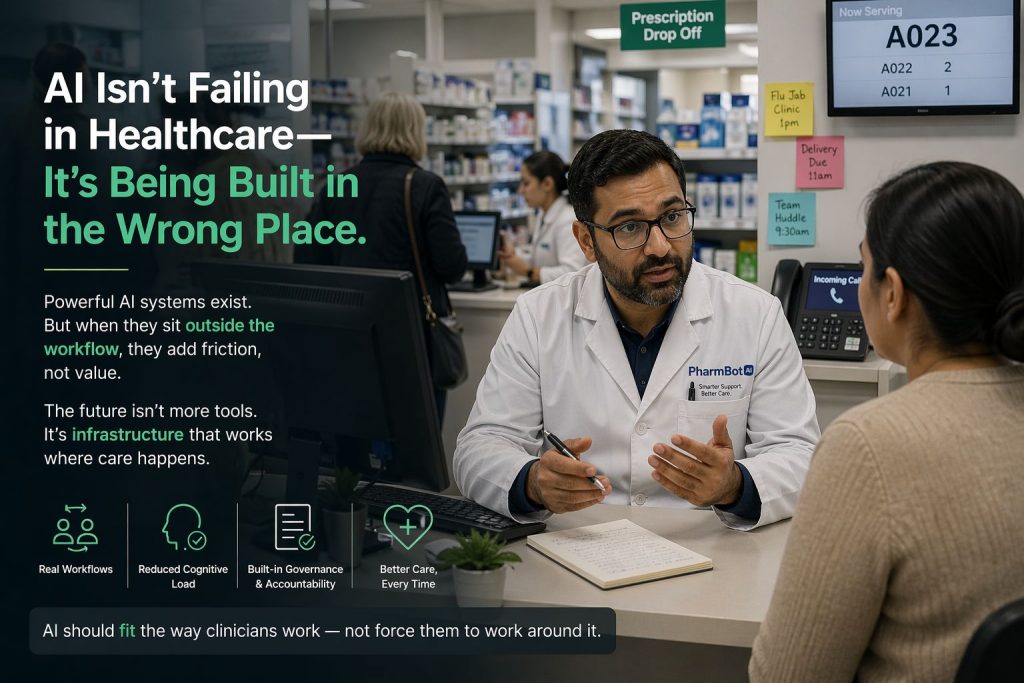
Artificial intelligence has become one of the most discussed topics across the NHS.
From policy papers to conference panels, the narrative is clear: AI will improve access, reduce workload, and transform clinical care.
But if you step into a real pharmacy on a busy weekday morning, that transformation is nowhere to be seen.
- The queue is building.
- The phone is ringing.
- Consultations are happening under pressure.
And AI—despite all the discussion—is largely absent.
That disconnect is not accidental, it is structural.
The Problem Isn’t Capability
There is no shortage of powerful AI systems. Modern models can interpret clinical information, generate structured documentation, and support decision-making at a level that would have seemed impossible a decade ago.
The issue is not what AI can do.
The issue is where it sits.
In most cases, AI in healthcare exists outside the clinical workflow. It is something clinicians must open, input data into, and then return from. Another system. Another step. Another interruption.
In theory, this is manageable.
In practice, it fails.
Because clinical work does not happen in controlled environments. It happens in real time, under pressure, with interruptions, competing priorities, and full professional accountability.
When a system adds friction—no matter how intelligent it is—it is quietly abandoned.
The Placement Problem
This is the central issue. AI is not failing in healthcare because the technology is inadequate. It is failing because it is being built in the wrong place.
This is a theme I explore in more depth in my upcoming book, Built in the Wrong Place, where I examine how even highly capable systems fail when they sit outside real clinical workflows.
Most systems are designed as add-ons rather than infrastructure.
They sit alongside care delivery instead of inside it.
To use them, clinicians must change how they work:
- Switch interfaces
- Re-enter information
- Break their cognitive flow
In high-pressure environments, this is not sustainable.
Clinicians do not reject AI because they are resistant to change.
They reject systems that make their work harder.
What Clinical Work Actually Looks Like
There is a persistent assumption in healthcare technology that consultations are linear:
History → Assessment → Decision → Documentation
That model works in training. It does not reflect reality.
In a community pharmacy, consultations are dynamic, interrupted, and non-linear.
Information emerges unpredictably. Staff ask questions mid-consultation. The phone rings. Another patient is waiting.
This reality—and the gap between theory and practice—is something I discuss extensively in both my recent PM Healthcare Journal article and in my book, drawing directly from real-world pharmacy environments rather than controlled demonstrations.
And crucially, the pharmacist remains accountable for every decision.
That means any digital system must do more than provide answers.
It must support reasoning in real time, without disrupting it.
From Tools to Infrastructure
AI in healthcare is still largely discussed as a set of tools:
- Decision support tools
- Documentation tools
- Chat-based assistants
But tools alone do not change practice.
Infrastructure does.
Infrastructure:
- Integrates into workflows
- Aligns with governance
- Scales with clinical services
- Supports consistency and accountability
This shift—from tools to infrastructure—is central to how AI will need to evolve if it is to deliver meaningful impact in frontline care.
A Personal Perspective
Over the past two years, I have been building AI systems specifically for pharmacy environments. Not in theory, in real settings. What has become clear is this:
Even highly capable systems fail if they sit outside workflow. And relatively simple systems succeed if they are placed correctly within it.
This is not a theoretical argument. It is based on direct experience of systems being used—and just as often, quietly abandoned—when they do not fit into practice.
The difference is not subtle.
It is the difference between technology that is demonstrated…
and technology that is actually used.
Final Thought
Healthcare does not reward what is impressive. It rewards what is reliable.
An AI system that performs consistently in a real consultation—under pressure, with interruptions, and with full accountability—will do more for patient care than any system that only works in demonstration.
AI in healthcare is not failing.
It is simply being built in the wrong place.