

A recent peer-reviewed study published in Digital Health explored the adoption of generative artificial intelligence among pharmacists and pharmacy students.
One observation stood out.
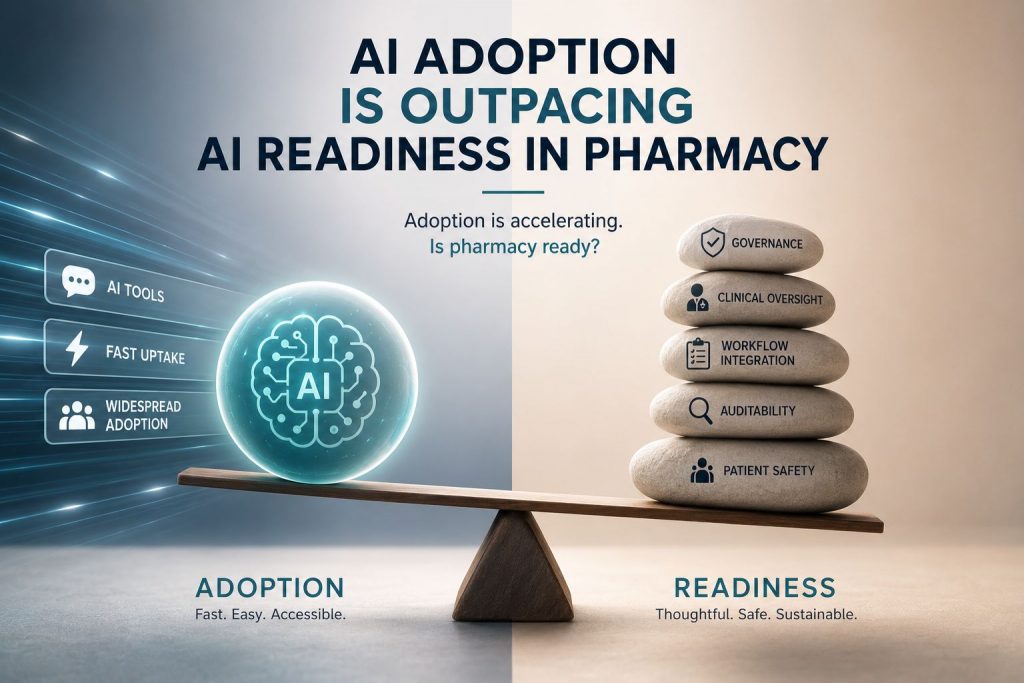
As AI adoption increases, understanding does not always keep pace.
Healthcare professionals are increasingly using tools such as ChatGPT and other generative AI systems, yet many have received little formal training on AI governance, validation, limitations, or appropriate clinical use.
This creates an important challenge for healthcare.
The easier AI becomes to use, the easier it becomes to use incorrectly.
Unlike many industries, the consequences of inaccurate information in healthcare can directly affect patient safety, clinical decision-making, and service delivery. As AI tools become more accessible, the question is no longer whether they will be adopted.
The question is whether they are being adopted safely.
Interestingly, the paper also referenced PharmBot AI as an example of a platform being developed for regulated pharmacy environments, including NHS workflows.
The study was not focused on PharmBot and did not evaluate the platform. However, the inclusion reflects a broader shift taking place across the profession. Conversations about AI in pharmacy are increasingly moving beyond theoretical possibilities and towards questions of governance, implementation, and real-world clinical integration.
This distinction matters.
For many organisations, the discussion around AI begins with the model itself. Which model is most powerful? Which tool generates the best response? Which platform has the newest features?
In practice, these are often the wrong questions.
Healthcare does not fail because technology is unavailable.
Healthcare innovation often fails because technology is introduced into workflows that were never designed to accommodate it.
Successful implementation requires more than access to AI.
It requires:
• Clinical governance
• Workflow integration
• Human oversight
• Auditability
• Professional accountability
• Continuous monitoring
Without these foundations, AI risks becoming another pilot project that generates interest but fails to deliver sustainable impact.
Community pharmacy is uniquely positioned to lead this next phase of adoption.
As one of the most accessible points of care within the NHS, community pharmacy understands the realities of patient-facing healthcare, medicines optimisation, risk management, and service delivery at scale.
The future of AI in pharmacy will not be determined by who adopts it first.
It will be determined by who implements it safely, effectively, and within the governance frameworks required to support patient care.
The technology is already here.
The challenge now is readiness.
Reference
Kahwaji A, Ismael R, Arnouk T, Alhomsy A, Alsuliman T. Adoption Rates and Knowledge of Generative Artificial Intelligence Among Pharmacists and Pharmacy Students: A Comparative Study in an Internet-Restricted Country. Digital Health. 2026.