

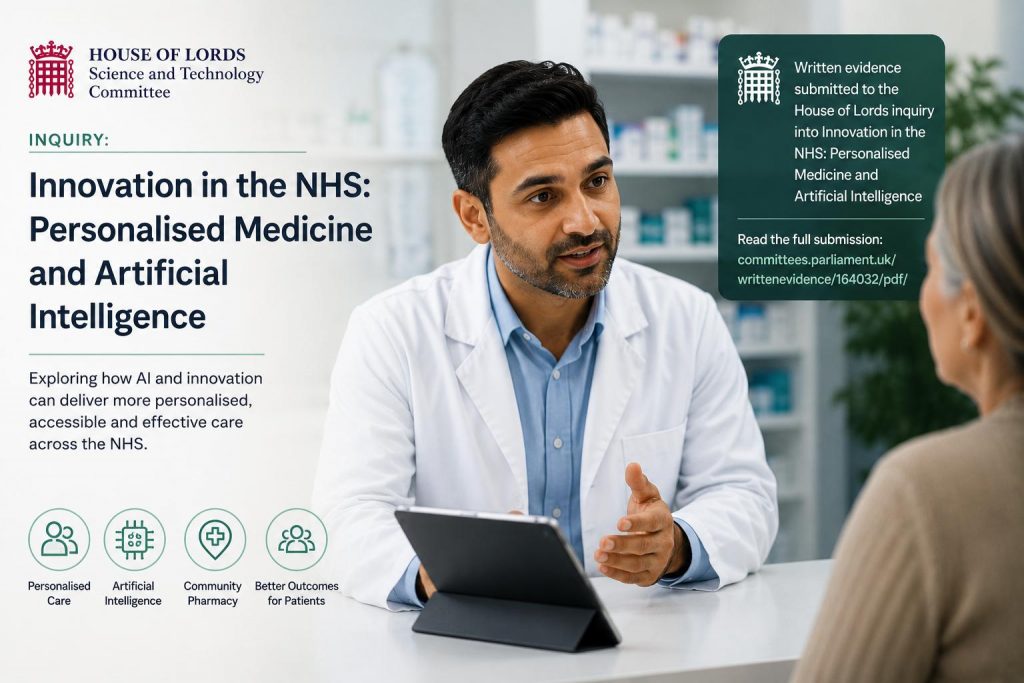
Earlier this year, I submitted written evidence to the House of Lords inquiry into Innovation in the NHS: Personalised Medicine and Artificial Intelligence. My submission, which can be read here, focused on an area that I believe is often overlooked in national conversations around healthcare innovation: the role of community pharmacy in delivering more personalised, technology-enabled care at scale.
The inquiry itself asks an important question: how can the NHS better support innovation in personalised medicine and artificial intelligence? It is a timely discussion. Across healthcare, there is growing excitement about the role of AI in improving outcomes, reducing pressure on overstretched services, and supporting more precise approaches to care. Yet despite rapid advances in technology, adoption across the NHS remains inconsistent and, in many areas, frustratingly slow.
Part of the challenge, in my view, lies in how we define personalised medicine. Public discussions frequently focus on genomics, precision oncology, advanced diagnostics, and specialist interventions delivered in hospital settings. These developments are important and undoubtedly represent part of the future of medicine. However, personalised medicine can also mean something much more immediate and practical: using individual patient information to make safer, more tailored clinical decisions during everyday healthcare interactions.
In many respects, community pharmacy has already been delivering a form of personalised care for years. Pharmacists routinely assess symptoms, medication histories, co-morbidities, contraindications, allergies, and patient preferences before making treatment recommendations. Every consultation involves balancing clinical guidance against the specific circumstances of the person in front of us. What changes from patient to patient is not necessarily the evidence base, but how that evidence is applied.
Artificial intelligence presents an opportunity to strengthen this process, not by replacing healthcare professionals, but by supporting them. When used appropriately, AI can help structure consultations, surface relevant guidance, identify patient-specific risks, highlight red flags, and reduce the administrative burden associated with documentation. This becomes particularly important in environments where clinicians are managing increasing workloads while attempting to maintain safe and consistent standards of care.
However, conversations around healthcare AI often become polarised. On one side, there is enthusiasm that AI will transform healthcare almost overnight. On the other, understandable concerns around safety, bias, accountability, and professional trust. The reality is likely to sit somewhere between these extremes. AI in healthcare should not be viewed as autonomous clinical decision-making. Instead, its greatest value may lie in functioning as clinical decision support — strengthening professional judgement rather than replacing it.
This distinction matters because healthcare operates differently from most other sectors. Success is not determined simply by whether technology is technically capable. It is determined by whether it can function safely, transparently, and consistently within the realities of clinical care. Healthcare professionals need systems they can trust, understand, and challenge when necessary. Patients need reassurance that technology is supporting care, not undermining accountability.
Community pharmacy offers an especially valuable lens through which to view this challenge. It remains one of the most accessible parts of the NHS and increasingly delivers clinical services that go far beyond traditional dispensing. Programmes such as Pharmacy First demonstrate how pharmacists are already managing structured clinical pathways, assessing patients, making treatment decisions, and supporting access to care closer to home.
Drawing on practical experience from structured Pharmacy First consultations, one lesson becomes increasingly clear: technology succeeds when it supports workflow rather than disrupts it. Pharmacists do not necessarily need more complexity. They need tools that help structure decision-making, reduce unnecessary administrative burden, improve consistency, and allow more time to focus on patient care. Importantly, the clinician must remain accountable, with technology acting as a support layer rather than a substitute for professional expertise.
Yet despite the growing potential of AI-enabled care, innovation within community pharmacy often receives less attention than hospital-based technologies or specialist interventions. This may represent a missed opportunity. If the NHS is serious about expanding personalised medicine, then community pharmacy should form part of that conversation. Few parts of the health system are as accessible, scalable, and embedded within local communities.
At the same time, one of the clearest lessons from developing and piloting healthcare technologies is that innovation does not fail solely because the science is lacking. More often, it struggles because of the realities of implementation. In my submission to the House of Lords inquiry, I highlighted several recurring barriers that continue to affect innovators attempting to deploy solutions into routine care. These include fragmented procurement pathways, regulatory uncertainty, interoperability challenges, and commissioning models that do not always reward efficiency, prevention, or improved workflow.
These barriers are not abstract concerns. They directly shape whether promising technologies remain isolated pilots or become embedded into day-to-day clinical practice. While healthcare is rich with innovation, there often remains a significant gap between demonstration and deployment. Bridging this gap will require more than technological capability alone. It will require healthcare systems that are prepared to adopt innovation safely, consistently, and in ways that fit frontline practice.
The House of Lords inquiry arrives at an important moment for healthcare. Artificial intelligence is rapidly moving from concept to practical application, while expectations around personalised care continue to grow. The question is no longer simply whether AI can contribute to better healthcare. Increasingly, evidence suggests that it can. The more important challenge is ensuring that technology strengthens clinical practice, maintains patient trust, and supports professionals working under growing pressure.
If personalised medicine is to fulfil its promise, the conversation cannot be limited to specialist centres, advanced diagnostics, or future scientific breakthroughs. It must also include the realities of frontline care, where millions of clinical decisions are made every day. Community pharmacy, supported by carefully governed and clinically integrated technology, has the potential to become an important part of that future.
Further Reading
My written evidence submitted to the House of Lords inquiry into Innovation in the NHS: Personalised Medicine and Artificial Intelligence can be accessed here.